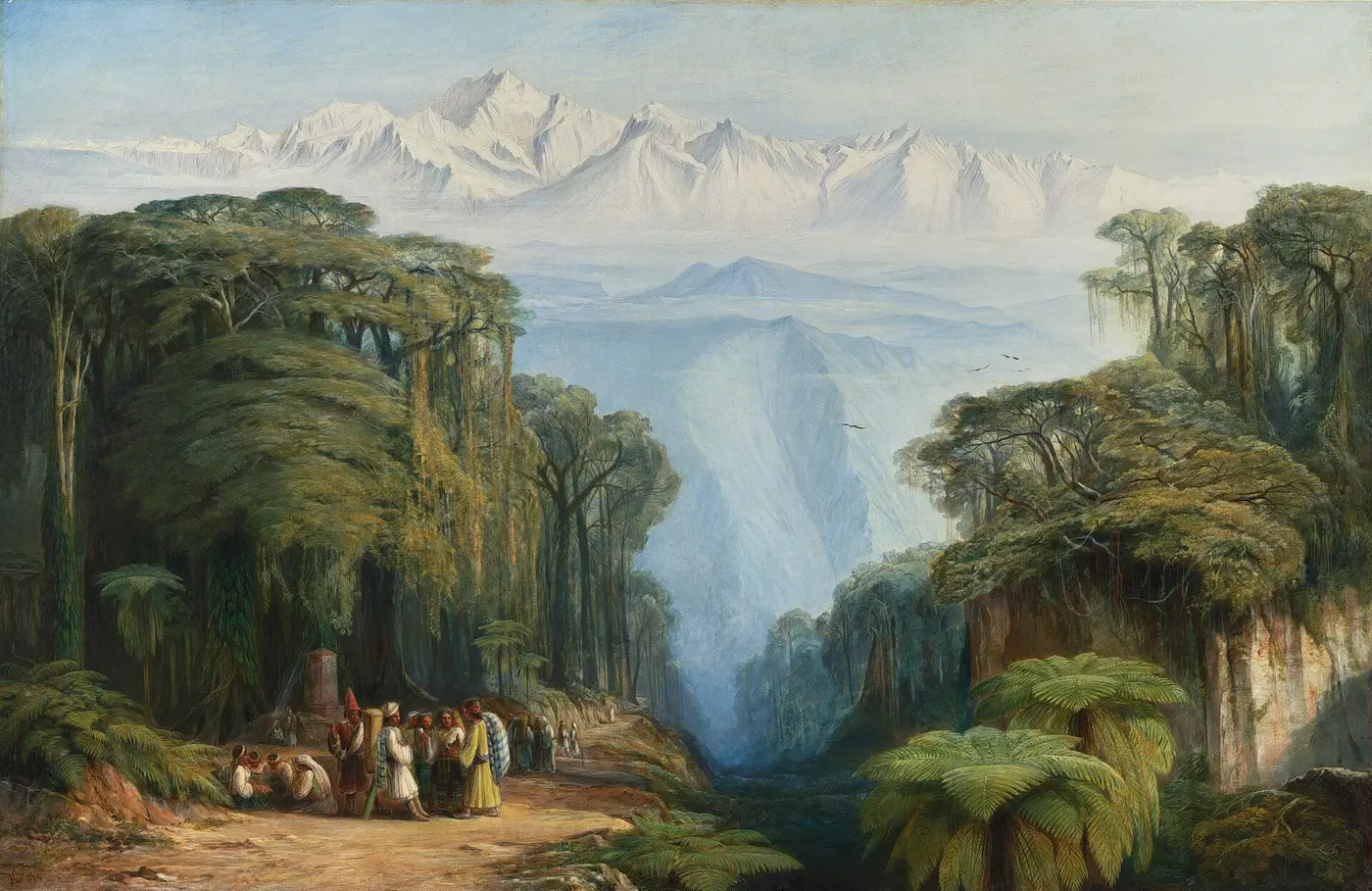

Before tea: a hill station is born
In the early 19th century the Darjeeling ridge was a thinly populated, forested spur belonging to the Chogyal (king) of Sikkim. In 1835 the British East India Company obtained the tract by a deed of grant. It wanted the land as a cool sanatorium for officials and soldiers escaping the heat of the plains. Roads, bungalows and a growing town followed.
Dr Archibald Campbell's experiment (1841)
In 1839 Dr Archibald Campbell, a Company civil surgeon, became Superintendent of Darjeeling. In 1841 he planted China tea seeds, generally said to have come via Kumaon in the western Himalaya, in his garden at Beechwood, his residence on the ridge. The bushes thrived. Other experimental plantings followed in the 1840s, and the Company began distributing seed to would-be planters.
All this happened in the shadow of the British effort to break China's monopoly on tea. Between 1848 and 1851 the botanist Robert Fortune famously smuggled tens of thousands of tea plants and seeds, along with Chinese tea workers, out of China for the Company. His material mainly went to the North-Western Himalaya. Even so, his mission secured the China-variety stock and know-how that shaped hill tea in India.
The first gardens (1850s)
Records commonly name Tukvar, Steinthal and Aloobari as the first tea gardens laid out around 1852, though some sources date Tukvar to 1850 and Steinthal to 1847. Commercial production is usually dated to 1856. In 1859 a tea factory was commissioned at Makaibari near Kurseong, often cited as the first in the district. Happy Valley (1854) and Glenburn (1859) belong to the same pioneering decade.
Growth was explosive. Contemporary district accounts record 39 gardens by 1866, and more than 100 by the mid-1870s. Much of the forest on the ridges was cleared for tea, and labourers, largely Nepali-speaking migrants, were recruited to plant and pluck. Their descendants are still the backbone of the gardens today.
The Toy Train (1881)
In 1881 the Darjeeling Himalayan Railway reached Darjeeling. This 2-foot (610 mm) gauge line from the plains climbs through loops and zig-zag reversals and is affectionately called the "Toy Train". It made moving tea, coal and people vastly cheaper. In 1999 it became the first hill railway inscribed as a UNESCO World Heritage Site (now part of the "Mountain Railways of India").
After independence
After 1947 most British-owned gardens passed to Indian companies and families. The Tea Act of 1953 created the Tea Board of India (constituted 1954), which regulates the industry, oversees tea auctions and holds the Darjeeling certification marks. The industry has since faced ageing bushes, labour disputes, political unrest, climate stress and cheaper look-alike teas.
Protecting the name
As fakes multiplied, the Tea Board moved to protect "Darjeeling":
- 1983: a Darjeeling logo was created to identify genuine tea. It was later registered as a certification trademark in India (1986) and abroad.
- 2004: Darjeeling tea became India's first Geographical Indication, holding GI registration numbers 1 (word) and 2 (logo).
- 2011: the EU registered Darjeeling as a Protected Geographical Indication under Implementing Regulation (EU) No 1050/2011. It was the first Indian product with EU protection, with a five-year transition for blends.
Timeline at a glance
- 1835Sikkim grants the Darjeeling tract to the East India Company as a sanatorium.
- 1839Dr Archibald Campbell becomes Superintendent of Darjeeling.
- 1841Campbell plants China tea seeds at Beechwood.
- 1848–51Robert Fortune's China mission secures tea plants, seed and workers for the Company.
- c.1850–52First gardens: Tukvar, Steinthal and Aloobari.
- 1856Commercial tea production begins.
- 1859Makaibari tea factory commissioned near Kurseong.
- 1866 → 1870sGardens grow from 39 to over 100.
- 1881Darjeeling Himalayan Railway opens to Darjeeling.
- 1953–54Tea Act passed; Tea Board of India constituted.
- 1983Darjeeling logo developed to certify genuine tea.
- 1999Toy Train becomes a UNESCO World Heritage Site.
- 2004Darjeeling becomes India's first GI (registrations no. 1 and 2).
- 2011EU grants Darjeeling PGI status.
- 2014A Makaibari tea fetches a widely reported US$1,850/kg.
- 2017A 104-day shutdown during the Gorkhaland agitation wipes out most of the second flush.
- 2024Production falls to about 5.6 million kg, a fraction of the 14.5 million kg made in 1990.
Questions & answers
Who started Darjeeling tea?
Dr Archibald Campbell, the Superintendent of Darjeeling, is credited with planting the first China tea seeds at his Beechwood garden in 1841.
What is the oldest tea garden in Darjeeling?
Tukvar, Steinthal and Aloobari are generally cited as the first gardens (c. 1850–1852). Makaibari is often credited with the district's first tea factory, in 1859.
When did Darjeeling tea get GI status?
In 2004 Darjeeling tea became the first product registered under India's Geographical Indications Act. The EU granted it Protected Geographical Indication status in 2011.